ts4rw

ts4rw
True Science for a Real World
Showing posts with label newton. Show all posts

Tuesday, August 2, 2011

Newton's Third Law of Motion for the Real World

The first thing that pops into mind when you think about Newton's Laws is "aha! Action and reaction" and curiously enough, that's a great overview of the last out of three laws of motion.


The Director sets the Actors in motion - Action & Reaction.
Perhaps the real mystery is what was I thinking of the crossover of Gandalf and Harry Potter?! 


Another way to put it plain and simple is to say that this is the karma law of physics; if you do something, something will happen to you.


We already saw while studying Isaac's Second Law that if you do something with little force, something little will happen in return. Also, that if the trend of the system is not to react (let's call it inertia, heaviness or the state of not wanting to change) will also affect the results of your actions.

So, we shall state that:
If you do something, something is going to happen to you.
This might sound a little bit like a threat... and it is.

How does it work then?? Doing something in particular will generate a reaction. For instance the office worker who is abruptly procrastinating, is not moving at all, hence no actions are taking place, therefore no reactions will occur. However, when his boss walks in [action] he immediately starts typing keys and moving his computer's mouse all around [reaction].

The Law of Action and Reaction states that forces come always in pairs and are equivalent in magnitude, but opposite in direction... WHAT?!


That means that the larger the action, the larger the reaction will be.

Back to the example: employee wondering around, just doing nothing...
[action] The janitor steps in to clean the waste paper basket... 
[reaction] Then the bureaucrat leans slightly over his monitor to pretend he is crunching numbers in his mind.
In this case, the presence of the janitor didn't cause great of a strain in the worker; the reaction was weak.


Different scenario:
[action] The boss's assistant walks in.
[reaction] This time, knowing the influence of this character, the bureaucrat picks up the phone, dials the supplier he just talked to an hour ago and talks nonsense for as long as the assistant is around. This time the action was stronger, as a consequence the reaction was too.

Yet another scenario:
[action] The CEO walks in.
[reaction] The employee instantly opens his workbook, dials the next supplier to arrange a meeting with while at the same time manages to write an email to his peers on the Supply Chain Management Division  with the information they requested a week ago...


Action & Reaction illustrated!
The janitor  makes no big action and therefore playing busy is the corresponding reaction.
When the C-Level walks in, the Supply Chain Management division gets a headache...


In a few words: action and reaction.


Further reading:
About Sir Isaac Newton
More about Newton
Even more about him
On the Third Law

Newton's Laws of Motion for the Real World:
First
Second

Thursday, March 17, 2011

Newton's First Law of Motion for the Real World

Many would think that the boring lessons of a first course in Physics would never have anything to do with real life. Perhaps you too, were one of the students sitting in the last row of the classroom, annoyingly saying things like "I'm never going to use this in real life, so why should I learn it now??" and right afterwards continue the hard labor of throwing a paper plane to tease the nerd sitting at the front row.

Paper-Plane Toss 101

Well, if that was your appreciation back then, read on...
I'm not going to state the Laws of Newton just as Sir Isaac did in his Principia, however if you must know, then read the Further Reading section. In the mean time, the First Law of Motion states in plain, understandable English:
If a thing is not moving and no one touches it, it won't move. In the same way, if a thing is moving and no one messes with it, it will continue to move.
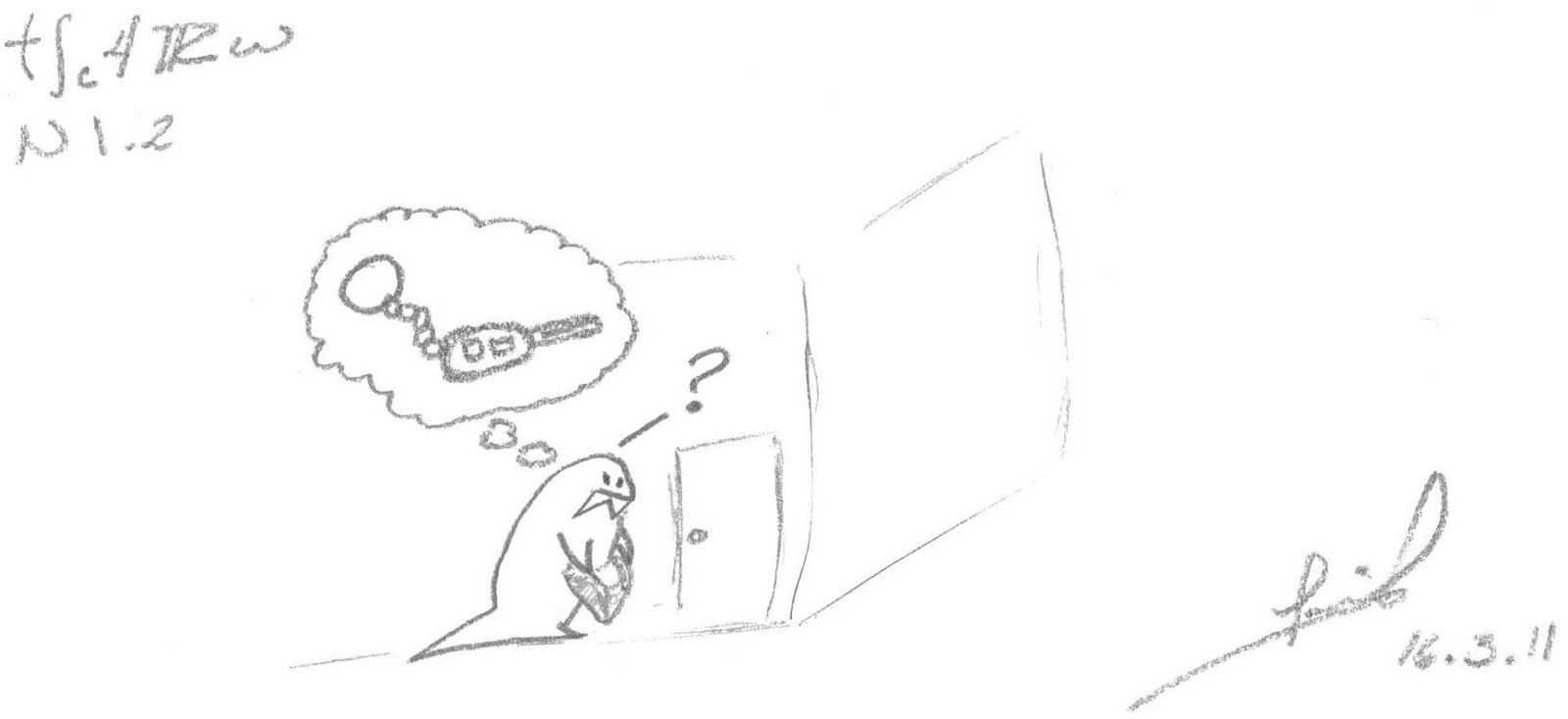
So stop jerking about your lost keys... If no one touched them, they're in the very same placed you left them.

Where are the keys? Where are the keys? Where are the $@%& keys?

But let's go a step further and try to see the magic of this in a contemporary environment: at the office!


So, if Newton was right and I interpreted him correctly, any procrastinating employee will continue to procrastinate unless an external factor is applied to him, say for instance:


1. The boss
2. Lunch time
3. His peers
4. Incoming critical work load


The state which now the employee adopts is no longer procrastination (not moving), since it has been affected by an external agent, now he is pretending to work, having lunch, talking about yesterday's Football match or actually working (moving).
In the same way, this employee will stay in that state (of moving) until again another external factor interrupts it. Say:


1. The boss walks away
2. Lunch time is over
3. Everyone agrees Manchester United kicks ass
4. Work is done

Procrastination Map

To sum up, you're all under Newton's scope and there's but a few things to do about it, enjoying it, being the best among the alternatives.

_________
Further reading:
http://en.wikipedia.org/wiki/Principia_Mathematica


Newton's Laws of Motion for the Real World:
Second
Third

Wednesday, March 16, 2011

Newton's Second Law of Motion for the Real World

Reading through my first entry on Newton's Laws is already something, but returning here again looking for the Second installment is something else. Specially cause most students find the Second Law to be the hardest to understand or even just to learn by memory in order to simply spit it on the exam.


Usual scene in a high-school Physics Exam


I no longer take Physics tests, so I have all the time in the world to try to explain this concept applied in a real bureaucratic ecosystem. Let's take a look!

We learned earlier that a thing will stay unchanged if it is left alone, right? But if it isn't?? Newton's Second Law states exactly that, which translated to XXI Century English means something like this:


The more force you use to move something, the more it will move. The heavier that thing is, the more difficult it is to move it.

Just that simple! Let's go back to the office example. Let's assume that having the boss walking in is more powerful than the 15:00 hrs lunch time alarm. So, the event of having the boss walking into the office and barking several instructions at the employee, will make him stop procrastinating instantly and will immediately start working on his boss's new assignments. However, if the alarm goes off, before getting up, the employee will perhaps yawn, think on what will he have for dessert and what will he do upon his return, before even turning off the alarm!


Relationship between Force and Acceleration: Large Force = Fast Action


Another example of the relationship between Force and Acceleration: Low Force = Slow Action


That's the first part of this law, which describes the change from the state of not moving to moving, which is proportional to the force causing this change.

The other part of Newton's Second Law states that heavier things are more difficult to move. By heavier I don't necessarily mean with more mass, but for our example it could also be more prone to procrastinate, having your mind elsewhere or just being sleepy. For instance, if the office employee of our example, missed last night's sleep, because he was hangover, his son was sick or a mosquito just didn't let him, the fact that his boss stepped in and issued a bunch of orders to be followed immediately, will be dismissed and maybe could make it to the to-do list, if lucky...


Relationship among all three variables: Force, Mass and Acceleration


So let's say that heavier means prone to inactivity


Therefore, we can see that acceleration (time to action) is directly proportional to the Force applied (stimuli which causes action) and inversely proportional to the mass (or heaviness; tendency to be inactive). Heck, even Newton had a formula for that!


F = ma


In conclusion, all of us are willing to take action if the stimuli for it is considered worthy. Very subjective stuff we're dealing with, but that is what defines our inertia, in some kind of way.


Newton's Laws of motion for the Real World:
First
Third